



The Key to Reliable Helical Pile Foundations
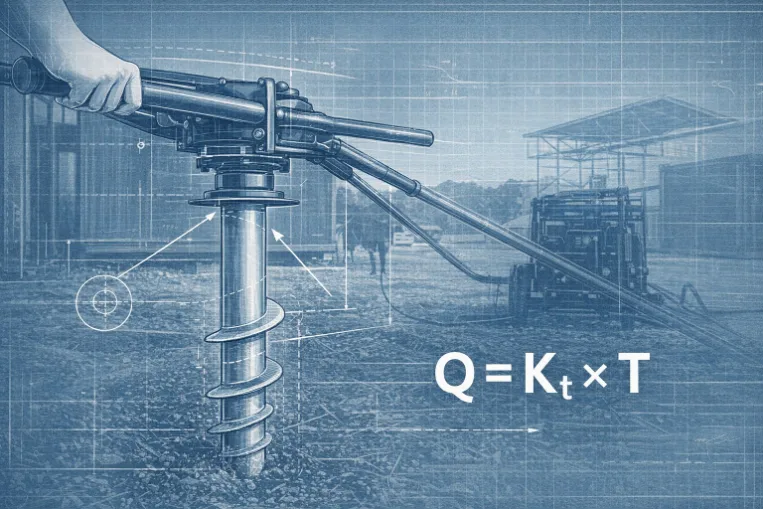
In the world of deep foundations, predictability is everything. One of the greatest advantages of helical (screw) piles is the ability to verify their load-bearing capacity during installation. This is made possible by a fundamental principle known as the Torque-to-Capacity Ratio.
- The Science Behind the Ratio.
The concept is simple but powerful: as a helical pile is twisted into the ground, the resistance it encounters (torque) is directly proportional to the strength of the soil and, consequently, the load the pile can support.
The empirical formula used by engineers worldwide is:
Qu = K_t× T
– Qu = Ultimate Bearing Capacity
– T = Final Installation Torque
– K_t= Capacity Correlation Factor
| Shaft Diameter (Imperial) | Shaft Diameter (Metric) | K_t Factor (Default) | Units (Imperial) | Common Applications |
| 2 7/8 “ | 73.0 mm | 10 | ft^(-1) | Decks, lighting poles, light residential |
| 3.50″ | 88.9 mm | 7 | ft^(-1) | New construction, solar arrays, tie-backs |
| 4/50 “ | 114.3 mm | 6 | ft^(-1) | Commercial foundations, heavy machinery |
Notice that as the shaft diameter increases, the K_t factor decreases. This is because a larger surface area of the shaft generates more skin friction during installation, which requires more torque that doesn’t directly contribute to the end-bearing capacity.
If you need to determine specific values, you can find them by consulting the International Standard ICC-ES AC358 (USA). This is the industry’s “gold standard.”
– What it is: Acceptance Criteria for Helical Pile Systems and Devices.
– Where to find it: Available on the official https://icc-es.org/ website.
- What it covers: This document officially codifies the “default” K_t values (e.g., 10 for 2 7/8″, 7 for 3.5″, etc.) that engineers are mandated to use in the absence of site-specific field testing. Most equipment and pile manufacturers worldwide reference AC358 as their primary technical authority.
- Why It Matters for Contractors?
– Real-time Verification: Unlike concrete foundations, you don’t have to wait weeks for tests. You know the pile’s capacity the moment you reach the target depth.
– Cost Efficiency: It reduces the need for expensive static load tests on every single pile.
– Safety: It ensures that every pile in the foundation meets the engineering requirements, even if soil conditions vary across the site.
- The Role of High-Quality Equipment for screw pile installation
The accuracy of the torque-to-capacity ratio depends entirely on two things: the quality of the pile and the precision of the installation equipment.
To get reliable data, contractors need:
- Consistent Torque Output: Fluctuations in hydraulic power can lead to false readings.
- Durability: Equipment must handle high pressure without losing calibration.
- Monitoring Systems: Modern drive heads should be compatible with digital torque indicators.
As manufacturers of pile-driving equipment based in Europe, we design our machines to provide the steady, high-torque performance required to meet these international engineering standards.
The torque-to-capacity ratio isn’t just a formula; it’s a promise of safety and efficiency. For modern builders, mastering this relationship means faster project timelines and rock-solid foundations.